arrow_upward

Phaethon [Radiant]

YEAR: 1986, 2009

COUNTRY:

Cateogry icon

Title of the resource

Phaethon

Title of the resource in english

Phaethon [Radiant]

Publisher

Panholzer Uitgeverij, 1986
C. C. Buchner Verlag, 2009


Original language

Latin, English

Target and Age Group

Teachers, advanced students of Latin, the general public, people with interest in classics

Link to resource

Phaethon

Accessed on 25 June, 2020

Contents & Purpose

Phaethon is a comic by Magda van Tilburg, in which she presents the myth of Phaethon according to Ovid: the phrases used by characters come from volumes I and II of Metamorphoses. The entire comic is written in Latin and it is only in the digital version that the original text is accompanied by an English translation. In addition to the translation, supplementary boxes contain explanations referring to proper names and morphological issues.

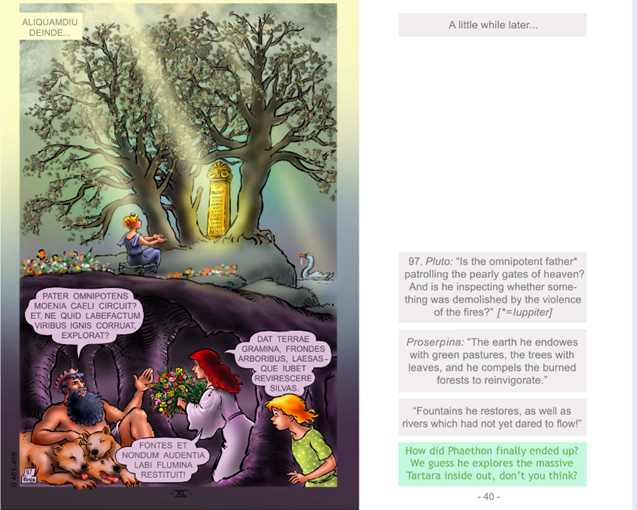
The myth of Phaethon is introduced from the perspective of the title character, seen not as a rebellious teenager hero trying to prove his worth, but rather as a young child raised by a single mother, laughed at by his peers. He seeks acceptance from an absent father and confirmation of his lineage but is stubborn, unwilling to accept advice from adults and unaware of the potential consequences of his actions. Phaethon asks his father to let him ride the chariot of the Sun. He does not realise how difficult, demanding of a task it is to control the horses so that they follow the horizon course. His conceit and insouciance result in the suffering of Tellus Mater and her people, very suggestively expressed by the author, as well as in the danger to the underground world and to the element of water. His lack of skills eventually causes the Sun’s chariot being knocked over from the horizon by Jupiter and leads to his death. His grieving sisters, the Heliades (Phaethousa, Lampetia, and Aegle), shown as young girls, change into poplars, and Cygnus turns into a swan, as described by Ovid. The myth ends with a family scene in which Pluto pets Cerberus, Proserpina brings to the Underworld a bouquet of meadow flowers as a symbol of the revival of the burnt Tellus Mater and Phaethon eventually finds his place in the (under)world (see below).

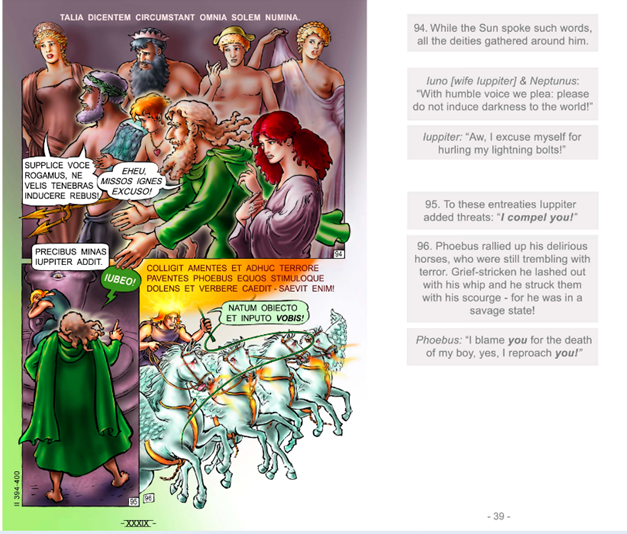
The portrayal of gods in the comic is based mainly on ancient sculpture and the fixed divine attributes present e.g., in ancient numismatics. For example, on page 39 one can easily recognize Juno, Pluto, Mercury, Venus, Neptune, Cupid, Jupiter and Proserpina, altogether trying to convince the Sun god Phoebus to return to his duties. He is always depicted emitting a solar glow, often also wearing a corona radialis diadem (see below), which he lends to his son for his one-time ride.


Photos courtesy of the author

Addenda


Photos courtesy of the author

Leaf pattern
Leaf pattern

Title of the resource

Phaethon [Radiant]

Title of the resource in english

Phaethon

Publisher

Panholzer Uitgeverij, 1986
C. C. Buchner Verlag, 2009


Original language

Latin, English

Target and Age Group

Teachers, advanced students of Latin, the general public, people with interest in classics

Link to resource

Phaethon

Accessed on 25 June, 2020

Contents & Purpose

Phaethon is a comic by Magda van Tilburg, in which she presents the myth of Phaethon according to Ovid: the phrases used by characters come from volumes I and II of Metamorphoses. The entire comic is written in Latin and it is only in the digital version that the original text is accompanied by an English translation. In addition to the translation, supplementary boxes contain explanations referring to proper names and morphological issues.

The myth of Phaethon is introduced from the perspective of the title character, seen not as a rebellious teenager hero trying to prove his worth, but rather as a young child raised by a single mother, laughed at by his peers. He seeks acceptance from an absent father and confirmation of his lineage but is stubborn, unwilling to accept advice from adults and unaware of the potential consequences of his actions. Phaethon asks his father to let him ride the chariot of the Sun. He does not realise how difficult, demanding of a task it is to control the horses so that they follow the horizon course. His conceit and insouciance result in the suffering of Tellus Mater and her people, very suggestively expressed by the author, as well as in the danger to the underground world and to the element of water. His lack of skills eventually causes the Sun’s chariot being knocked over from the horizon by Jupiter and leads to his death. His grieving sisters, the Heliades (Phaethousa, Lampetia, and Aegle), shown as young girls, change into poplars, and Cygnus turns into a swan, as described by Ovid. The myth ends with a family scene in which Pluto pets Cerberus, Proserpina brings to the Underworld a bouquet of meadow flowers as a symbol of the revival of the burnt Tellus Mater and Phaethon eventually finds his place in the (under)world (see below).

The portrayal of gods in the comic is based mainly on ancient sculpture and the fixed divine attributes present e.g., in ancient numismatics. For example, on page 39 one can easily recognize Juno, Pluto, Mercury, Venus, Neptune, Cupid, Jupiter and Proserpina, altogether trying to convince the Sun god Phoebus to return to his duties. He is always depicted emitting a solar glow, often also wearing a corona radialis diadem (see below), which he lends to his son for his one-time ride.


Photos courtesy of the author

Addenda


Photos courtesy of the author