Title of the resource
Title of the resource in english
Publisher
Wydawnictwo Draco Sp. z o. o.
Original language
Target and Age Group
6 -9 years olds, self-learners, homeschoolers
Link to resource
Accessed on 25 August, 2020
Contents & Purpose
The author took into account cognitive abilities of pre- and early-primary school age groups (6-9). Just as with modern language training, the emphasis is placed on communication skills of children, hence the reduction of grammatical commentary and absence of explanations of different phrases and grammatical structures, which are unnecessary at this stage. The learning happens through play, in an interesting and appealing way and provides children with the tools useful for their future exploration of European modern languages: they will be able to recognize the vocabulary which originated from Latin.
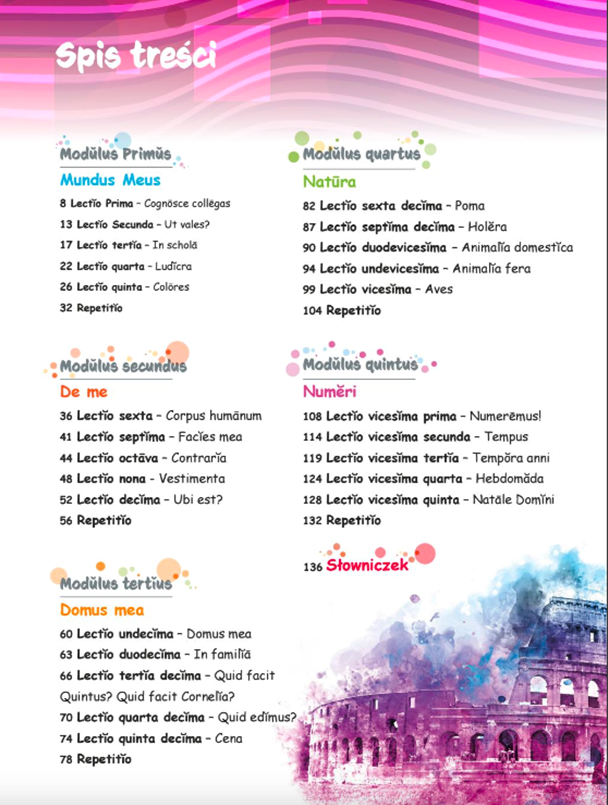
The textbook is divided into 5 units (moduli): The world around me (Mundus Meus), About me (De me), My home (Domus mea), Nature (Natura), and Numbers (Numeri). Each unit comprises 5 lessons (lectiones) and revisions (repetitiones) . At the end of the book the author also provides a glossary and an additional page with a certificate for the child who completed the course.
The subjects of the lessons are based on what the child already knows: its closest surroundings, for example the human body, home, school, toys, clothes, meals, domestic and wild animals, seasons of the year et al. Each lesson contains new vocabulary as well as phrases and sentences with new words.
There is also Did you know that…? section in each lesson containing a simple commentary (usually grammatical). The lessons end with exercitiones - exercises, fabulae - fun facts about the ancient culture (e.g., the resources about Hippocrates, Roman schools, toys, clothes, meals, Roman houses, as well as mythical stories), cantilenae - songs and sententiae - words of wisdom. The new vocabulary and phrases are richly illustrated, so that the pupil can intuitively understand the meaning of new words and concepts. The fabulae and sententiae are also accompanied by illustrations or photographs, often depicting artifacts of the ancient world or its reception in modern art and culture.
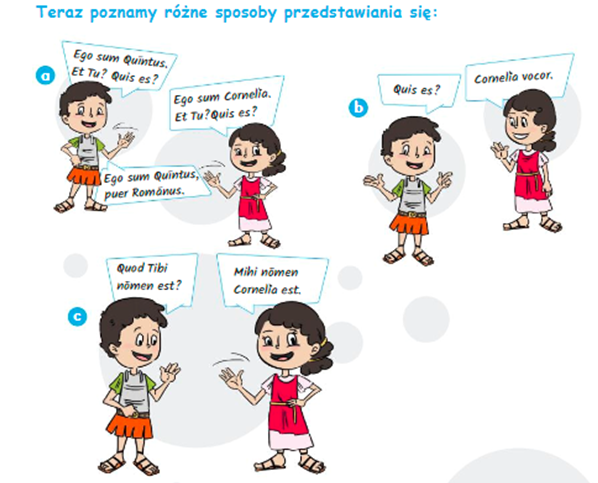
The pupils are “accompanied” in their learning process by two Roman children: Cornelia and Quintus. The textbook is colourful, its resources varied with a full range of exercises adapted to the pre- and early-primary school educational level. Also, a large, legible and sometimes colourful font has been used. Audio files connected to the textbook can be downloaded from the publisher’s website along with a sheet of motivating stickers to reward the pupil along the way.
The classical myths chosen by the author are introduced briefly, but they still contain the key elements. The textbook tells the story of King Midas and the Midas touch. To the myth of Apollo and Daphne, the author added her translation of an excerpt from Ovid’s Metamorphoses and a photograph of Bernini’s sculpture. The pupils also learn about Daedalus and Icarus or the Minotaur, Theseus, Ariadne’s thread and the Labyrinth. The twelve labors of Hercules are illustrated with ancient vases, mosaics, and paintings, and the pupil’s task is to identify the various monsters tackled by the hero. The legend of the Capitoline Geese is paired with a couplet from Livy and illustrated with a statue of Zeus. The myth of the Four Ages of Man is accompanied by brief excerpts from Ovid’s Metamorphoses. The myth of Demeter and Persephone is linked to the lesson about the seasons of the year.
Addenda

Cover courtesy of Wydawnictwo Draco